
The Texture Questions Outdoor Kitchen Builders Should Ask Before Ordering
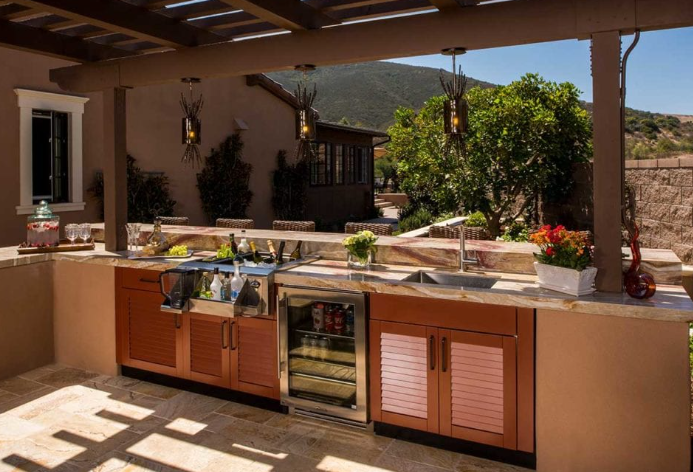
The prettiest texture on a house facade is usually the wrong one for a seat wall. Outdoor-living crews around Utah County pick from the same catalog a siding contractor uses, then wonder why the finished bench looks busy at knee height while the house behind it looks right from the curb. Anyone comparing pre cast stone ut profiles is making two decisions at once, how the stone reads from two feet away and whether the same shade and the same piece sizes will still be available when the outdoor kitchen gets built next spring. Photographs settle neither. Texture for outdoor living is a knee-height decision first and a reorder decision second, and that is the whole argument of this piece.
Seat Walls Read Differently Than House Facades
Stand in front of a house and you are twenty, forty, sometimes sixty feet back, and at that range a rough tumbled stone reads as one warm mass with a little shadow in it. Now sit down on a 30 inch seat wall. Your eye sits roughly a foot above the cap and about two feet out from the face, so every deep pocket, every irregular butt joint, every spot where the mortar sagged is right there at conversation distance. A seat wall has nowhere to hide. The texture that looked handsomely rugged from the sidewalk starts reading as noise, and guests do the thing where they run a hand along the face and find the sharp edge nobody noticed during layout.
Color behaves the same way up close, which is why the direction the material is heading matters to a backyard build. In August 2026, Masonry Magazine described 2026 manufactured stone veneer color as shifting decisively toward warm, sunbaked neutrals drawn from organic materials and regional landscapes, a cream, sand and gray palette the magazine says works across contemporary, transitional and traditional architecture. Palettes like that are forgiving at two feet. A high contrast blend carrying three or four strong values is not, because at sitting distance the eye stops reading a wall and starts counting individual stones.
Job after job, the same thing turns up at the walk-through. The wall is straight, the cap is clean, and the homeowner keeps glancing at one course near the middle where a single dark piece landed at eye level for anybody sitting down. On a second story gable nobody would ever find it. On the $2,000 to $5,000 of stone wrapping a fire pit and a bench, it is the only thing anyone sees, and it does not go away after the first party. Sample boards catch this, but only when somebody looks at them from the position the client will actually occupy, which almost never happens in a showroom with the board hanging at chest height under fluorescent light.
So set the sample where it will live. Four square feet propped on a scrap block at thirty inches, looked at in afternoon light, teaches you more than the whole catalog.
Texture Moved From Tumbled Rustic To Tight Ledge
Ten years ago the default for a Utah County backyard was heavy and tumbled. Deep relief, wide irregular joints, plenty of texture doing plenty of work. It matched the houses going up then, and it hid small setting errors, because a quarter inch of variance disappears into a face that already varies by an inch. Most of the outdoor-living work quoted now goes the other way, toward tight ledge profiles with clean linear courses, dry stacked, minimal joint, stated heights near 3 and 6 inches and lengths running roughly 4 to 16 inches.
That shift moved the difficulty from the stone to the mason. Tight ledge is unforgiving of a wall out of plane, and it announces a wandering level line from clear across the yard. What you get in return is a face that reads correctly at knee height, which is exactly where the client spends the evening.
Questions To Ask Before A Texture Order Ships
A texture order goes right more often on the phone than through a website form, because the things that decide the job are not the things a product photo answers. Ask before the truck loads, not after it arrives. How fast a supplier answers tells you something real about how the product gets made and stocked.
- Are the heights and lengths in this profile fixed or nominal? A good answer names the actual sizes, like 3 inch and 6 inch heights at 4 to 16 inch lengths, instead of saying it varies.
- How are corner pieces counted against my flat square footage? A good answer gives you a stated deduction per linear foot of corner so you can figure the order yourself.
- What happens to color consistency if I reorder this profile in four months? A good answer describes how batches are blended and what they do when a run drifts.
- Is this texture stocked or made to order, and what is the lead time on a partial reorder? A good answer gives a number of days, not a season.
The corner question catches new crews the hardest. Corners get sold by the linear foot and deducted from your flat footage at a set rate, so a fire pit with eight outside corners plus an island wrap can swing a $3,400 stone order by a few hundred dollars in either direction before anybody picks up a trowel. Run that math at the quote stage while the client is still choosing, because the profile with the tidier corner count sometimes wins on price alone.
See also: Transforming Business Efficiency Through Outsourced Payroll Solutions
Pick The Texture Your Crew Can Set Twice
Phase two is the real exam. The seat wall goes in during May, the client loves it, and by September there is budget for the kitchen island wrap that has to match it. If the profile was a loose rustic blend with no published sizes, the second delivery shows up a shade off and a hair different in profile, and the two runs sit eight feet apart in full sun arguing with each other. Anyone shopping pre cast stone ut options for a Utah County backyard should read a texture page the way a mason reads it, hunting for named profiles with stated heights, lengths and color families rather than for the best photograph. Pick the one your crew can set twice.